









































Introduction
Last year, Dubai welcomed 18.72 million tourists, a 9% increase from the previous year. This is not shocking due to the lavish environment that Dubai maintains through its golden beaches, luxury hotels, impressive architecture, and extravagant experiences. The glamour and glitz of the city appears so flawless to its visitors that Dubai is consistently voted one of the best travel destinations. But how does Dubai manage to create such an impressive and innovative environment? By using the labor of impoverished and desperate migrant workers, Dubai is able to create the utopian facade it presents to the rest of the world. Under the Kafala System, the United Arab Emirates (UAE) are able to exploit the vulnerability of desperate people in order to force them into what the UN has categorized as modern slavery.
The Kafala System
The Kafala system was a structure put in place by Gulf Countries in the 1950’s to help reach the labor demands of large scale infrastructure goals. By using foreign and cheap labor, the UAE was able to complete large projects despite their small population. (Council on Foreign Relations).
The Kafala system allows UAE employers to “sponsor” foreign laborers, covering their travel expenses and housing in exchange for a contract of servitude. Many workers come to Dubai under the pretense of starting a better life due to the higher wages, job stability, and economic security. However, upon arrival, the migrant workers soon discover that the promise of wealth and opportunity they were sold on was nothing more than a facade.
Immediately after landing in Dubai, most migrants are made aware that although their sponsor company might have initially covered the cost of transportation from their home country, they will be expected to reimburse this investment via deductions to their salaries or a simple interest plan. Despite the fact that Emirates law forces sponsor companies to cover the flight fees, many find loopholes to force workers to pay their own transportation fees. Because this is unobtainable by the workers, they are further pushed into the impending web of slavery and forced dependence.
Some companies choose to take it a step further by confiscating migrant workers’ passports claiming it’s for “safe keeping.” This chains employees to their sponsor companies, and effectively prohibits them from being able to quit if necessary. But this initial shock doesn’t measure up to the horrors of what truly awaits them at their job.
Life working under the Kafala system
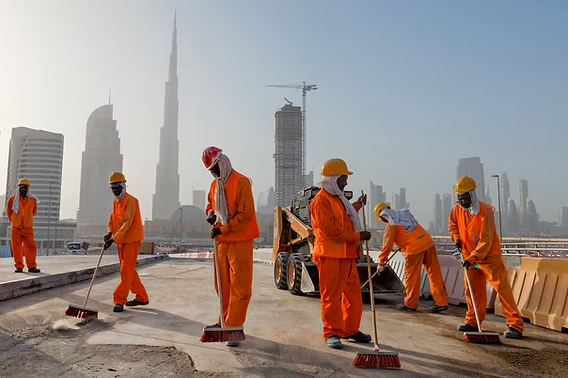
Many migrants are soon subjected to intense 12 hour work days, sometimes lasting 7 days a week. The shifts are typically filled with hard labor in temperatures that can exceed 120 degrees Fahrenheit. According to interviews from Human Rights Watch (HRW), workers reported nosebleeds, vomiting, dizziness, and fainting due to the extreme heat. “Our clothes become so hot they burn”, says a security guard working in the UAE. In addition to the gruesome working conditions are the unfair rules surrounding their days off. A Pakistani worker told HRW that if they miss one day of work their employers will deduct 3 days worth of pay from their already sparse salary.
On top of inhumane work hours, many laborers soon realize that the hefty wages they were promised was nothing more than a lie upon receiving their paycheck. Along with a meager salary of on average $175 a week, the majority of workers experience delays in payments and a withholdment of wages in an attempt to further their desperation and attachment to their employers.
Additionally, the housing that sponsor companies provide to workers is not the good deal the foreign workers think it is. Reports indicate extreme overcrowding, unsanitary conditions, and health risks in the company-appointed housing. According to the Emirati Times, a 2024 investigation undertaken by the UAE ministry of Human Resources found 352 violations in labor camps across UAE territory. But this isn’t all migrant workers have to deal with in the UAE.
According to HRW, “For a migrant worker, changing jobs within the UAE is a cumbersome, bureaucratic process and requires the consent of the original employer.”
Restrictive policies make changing jobs nearly impossible for migrant workers resulting in many workers just submitting themselves to the system of abuse and pain that awaits them.
Reformations
Starting in the early 2000’s, human rights organizations started taking notice of working conditions of migrant workers in the UAE. But it was only when a 2009 article titled “The Island of Happiness” was published that public outrage surrounding the oppressive Kafala system erupted. People from all over the world expressed their shock and called for immediate reform.
Following public backlash, the UAE introduced many laws and policies adding protections to workers. The majority focused on allowing workers to resign from their jobs without risking losing their work permits, as well as protections against salary abuse. Despite this, the actions taken by the UAE are mediocre when compared to steps taken from other countries when accused of similar problems. According to Walk Free, “..the UAE has taken limited action to address modern slavery despite having larger resources at its disposal. Further, the government has not made efforts to eradicate modern slavery from government and business supply chains.” The UAE’s level of inaction due to restrictive laws has led to continued protests and investigations in an attempt to create a better environment for the estimated 9.8 million laborers working under the Kafala system.